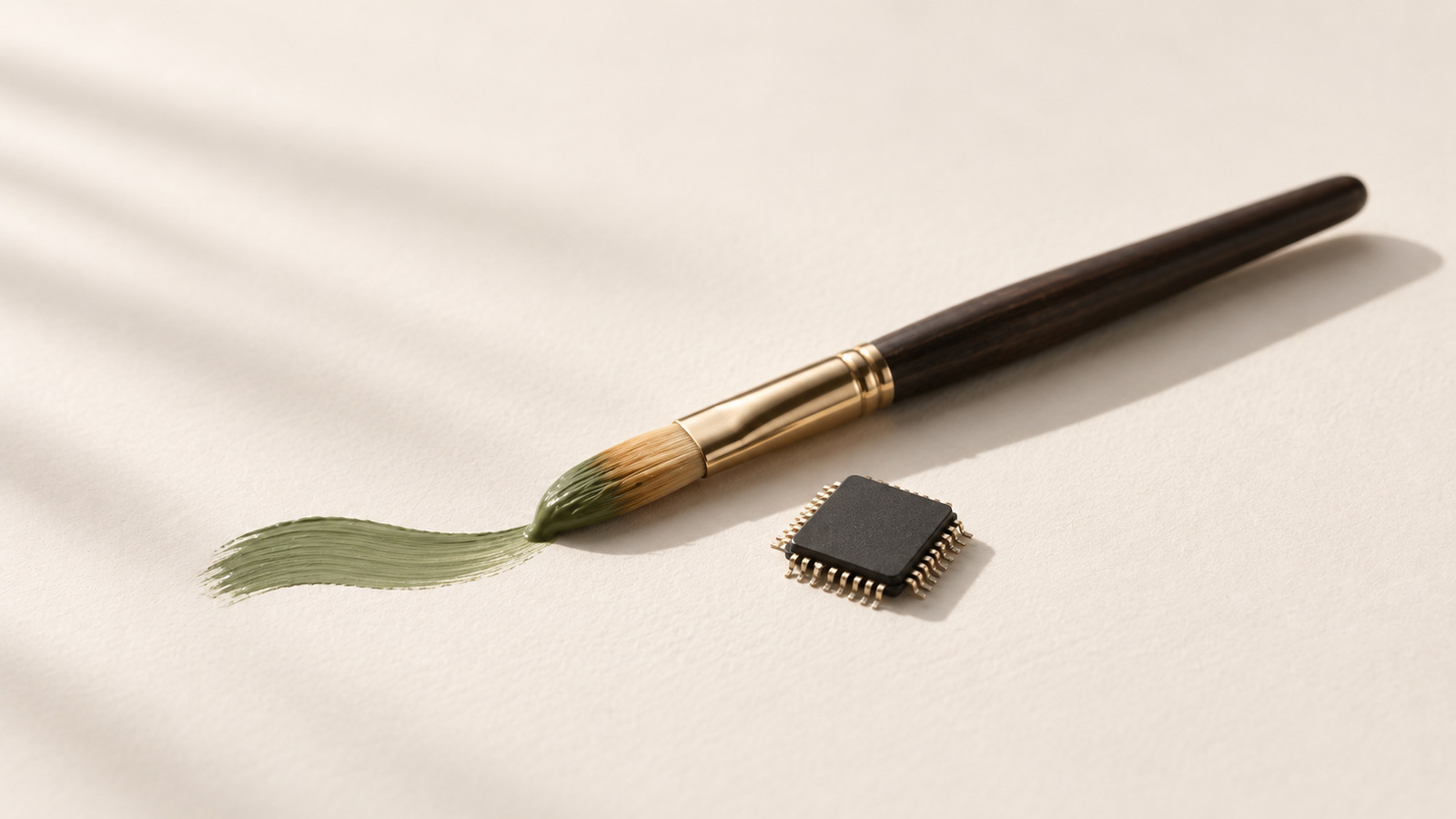
AI can now write a poem, compose a song and paint a picture in seconds, which has turned an old philosophical puzzle into a practical one. Is what it produces creative? Does it make people more creative, or less? And what happens to the value of human creative work when imitation becomes free? The short answer is that AI is very good at producing variations on what already exists, useful as a partner in the early, messy stages of creative work, and much weaker at the thing people usually mean when they call someone creative: having something of their own to say.
I teach writing, so I come at this from the desk rather than the lab. What follows is what the research says so far, and what I think it means for anyone who makes things.
What AI is actually doing
A generative model learns statistical patterns from an enormous amount of human work: text, images, music, code. When you ask it for something, it produces an output that fits those patterns and your instructions. It can combine styles, recombine ideas and generate many options quickly, and the results can be surprising, attractive and occasionally striking.
Researchers who study creativity often separate two things: novelty, meaning something new, and value, meaning something that works or matters. AI can produce plenty of both in a narrow sense. What it does not have is a reason to make the thing. It has no experience it is trying to put into words, no argument it needs to win, no picture it cannot get out of its head. Every intention in the process comes from the person asking.
That is why the most interesting question is not whether AI is creative in the abstract. It is what happens to human creativity when people work with it.
What the studies have found
The evidence is still young, but a few results are worth knowing.
In a study published in Science Advances in 2024, Anil Doshi and Oliver Hauser asked several hundred people to write short stories, some with ideas suggested by an AI model and some without. Readers judged the AI-assisted stories as more creative and better written, and the effect was strongest for the writers who had been rated least creative to begin with. But there was a catch. The AI-assisted stories were also more similar to one another. Individually, the writing improved. Collectively, it became more uniform.
That pattern shows up elsewhere too. Tools that suggest the most likely next idea tend to pull everyone toward the same likely ideas. For a single person on a deadline, that can be a gift. For a culture, it is a quiet risk: more competent work, and less variety.
Other studies of brainstorming suggest that AI is good at producing a long list of options quickly, often matching or beating people on the sheer number of ideas, while the most original ideas still tend to come from people who used the list as a starting point rather than a menu.
Where it helps
AI is most useful at the stages of creative work where volume matters more than voice.
Getting unstuck. A blank page is the hardest one. Asking for twenty possible openings, titles or angles, most of them bad, is often enough to show you what you actually want.
Seeing alternatives. Asking how a paragraph would sound shorter, plainer or angrier, or how a scene would look from another character’s point of view, is a fast way to test choices you might not have considered.
Doing the dull parts. Formatting, summarizing research notes, checking consistency, turning a draft into several versions for different places. Time saved there can go into the parts that matter.
Playing critic. Asking a model to point out weak spots in your own draft can be surprisingly useful, as long as you remember that you decide which criticisms are right.
Where it does not
The same tools become a problem when they take over the part of the work that was the point.
If the first draft is always the machine’s, the writer never finds out what they would have said. Creative skill is built by struggling with the blank page, and that struggle cannot be outsourced without losing what it produces. Anyone who teaches writing can see why: a writer who lets the tool start every piece skips the one step that builds the skill.
There is also the question of voice. Text generated from the average of everything tends to sound like the average of everything: fluent, balanced and forgettable. A distinctive voice comes from particular choices, odd preferences and personal experience, which are exactly what a model trained to predict the likely does not have.
Who owns the result
Law is still catching up, but the direction in the United States is fairly clear. The U.S. Copyright Office has said that copyright protects human authorship, and that material generated entirely by AI cannot be registered, although a work that combines AI output with enough human creative contribution can be protected for the human parts. In March 2025 a federal appeals court upheld the refusal to register an image produced autonomously by an AI system. Other countries are taking their own approaches, and there are separate, unresolved legal fights over whether training models on copyrighted work requires permission or payment.
For anyone making things, the practical point is simple: the more of yourself there is in the work, the stronger your claim to it, legally and otherwise.
Using it without losing yourself
The approach I would recommend comes down to a few rules. Have the first thought yourself, even if it is rough. Use the tool to widen your options, then make the choice yourself. Never publish a sentence you could not defend as your own. And read your work aloud: if it sounds like nobody in particular wrote it, nobody did.
AI will not end human creativity, and it will not replace it. It will make competent work cheap, and that will make work with a real point of view easier to notice, and worth more. For the skills that help people use these tools well, see AI Literacy, and for the wider picture, How AI Is Changing the World.